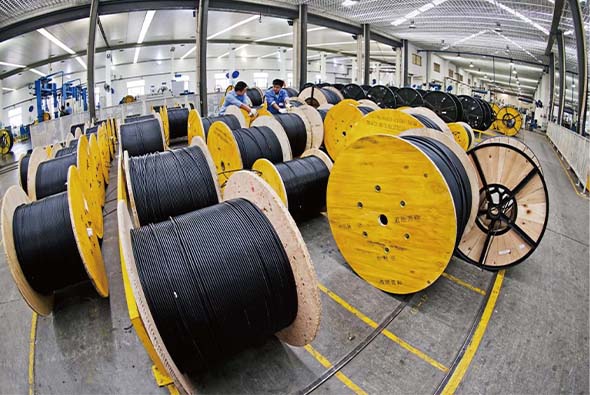
quality laminated indoor fiber optic cable attenuation controlled series
Lightwave communication strand has transformed how people exchange data in today's connected era.
Understanding within-building fiber deployments
Fiber-based cabling is fundamental to today's networked world.Within-building fiber installs present specific difficulties and chances.Efficient optical cable installation copyrights on knowing components and following routing and termination best practices.Selecting the right fiber kind per bandwidth and intended use is critical.Additionally, skilled technicians must adhere to strict safety protocols when working with fiber optic cables to prevent damage or breakage
- Careful planning and execution are essential for a seamless indoor fiber optic cable installation
- Elements including building geometry, current systems, and future capacity demands should be reviewed.
- Correct termination methods are vital for maintaining signal fidelity and dependable links.
Closing the indoor fiber optic cable digital gap
Outdoor optical cables act critically to close digital disparities.Rolling out fiber-optic networks over rural territories delivers equitable information access to communities.This connectivity buildout is indispensable for encouraging economic growth, enriching education, and empowering communities online
Fiber Optic Cables: Single-Mode vs Multi-Mode Overview
When moving data across great distances, fiber optics are the top choice.They exceed copper performance by supporting ultra-fast transmission and negligible loss.Nevertheless, fiber cable varieties differ significantly.Two main fiber formats prevail commercially: single-mode and multi-mode.
Single-mode fiber supports only one propagation mode through its core, true to its label.Thus, it experiences limited dispersion, excellent for long spans with low attenuation.Multi-mode fiber propagates multiple optical modes together, yielding higher capacity for short-range networks.Often chosen for on-site and campus networks, multi-mode suits short-distance data transport.
- Therefore, the choice between single-mode and multi-mode fiber depends on the specific application requirements.Where high capacity and long-haul links are required, single-mode fiber is optimal.Alternatively, multi-mode suits short-distance, high-bandwidth applications with lower cost.

Fiber Cable Merits
Fiber-based cabling has upgraded data transport by providing various benefits.A main merit is their extraordinary capacity for bandwidth.Unlike traditional copper cables, fiber optics can transmit vast amounts of data over long distances with minimal signal loss.High-rate transmission makes fiber optimal for heavy-data uses including streaming, gaming, and cloud computing.Plus, fiber systems are resilient—resistant to corrosion, damage, and electromagnetic disturbances.Such immunity helps ensure signal quality and reliable transfer even in severe environments.Furthermore, optical fiber enhances information security.Information conveyed through fiber is better shielded and challenging to intercept.This secure nature renders fiber suitable for sensitive sectors like banking and governmental communications.
Premium Fiber Optic Systems for Enterprise Use
Enterprise networks demand robust and reliable infrastructure to support mission-critical applications.High-performance fiber is ideal for enterprises for its bandwidth, latency, and EMI resistance.Advanced fiber systems furnish scalable, secure platforms for enterprise data, voice, and video needs.Modern fiber platforms use multimode, single-mode, and duplex configurations to ensure requisite enterprise speeds.Implementing fiber networks enables enterprises to optimize performance, cut costs, and strengthen market advantage.
- Top Advantages of Fiber Optic Solutions:
- Extremely Large Throughput Capability
- Near-Zero Delay for Interactive Applications
- Protected from EMI Effects
- Scalable Infrastructure for Expansion
- Improved Data Protection

Securing Your Return: Best Practices for Fiber Installs
Thorough planning of fiber installation is crucial to maintain network reliability.To optimize ROI on fiber, review the following best practices:Engage reputable fiber experts to design a tailored cabling solution.Use top-grade, protected cabling and accessories to limit signal loss and EMI.Make certain of proper termination techniques to secure optimal transmission.Perform routine maintenance and testing to catch problems before escalation.
Fiber Optic Cable vs. Outdoor Fiber Data Cable: Key Differences
Choosing the right fiber optic cable depends heavily on its intended use.Within-building fiber cables are built for indoor deployment with large bandwidth and limited attenuation.Such cables typically use lighter materials and flexible designs to ease installation in tight areas.Conversely, outdoor fiber variants withstand rugged environmental factors and weather.They include rugged UV-stable sheathing and reinforced connectors for dependable outdoor operation.
Here is a concise look at the primary variations:
- Material choice dichotomy: indoor versions are lighter for internal routing, outdoor ones are robust for environmental resilience
- Installation methods differ: indoor installs are generally simpler within controlled spaces; outdoor installs need specialized mounting, splicing, and weatherproofing methods
- Connector contrasts: indoor connectors suit controlled environments and frequent access; outdoor connectors are designed to withstand exposure and harsh conditions

Cable Standards and Regulatory Guidelines
The fiber industry leans on standardized specifications and regulatory frameworks to deliver interoperable, high-performing systems.These norms are produced by global organizations such as ISO and the IEEE.Key standards address aspects like cable construction, transmission characteristics, connector types, and testing procedures.Such regulatory frameworks also promote secure, reliable, and compatible deployment of fiber systems.
- Commercial adoption of standards is vital to facilitate effective design, make, and implementation of fiber networks.
- Following standards minimizes errors and ensures maximum data transfer performance.
Future Directions in Fiber Technology
Fiber technology is approaching a notable evolution fueled by rising needs for greater bandwidth, reduced latency, and improved security.One promising trend is the expansion of dense wavelength division multiplexing (DWDM) which allows for the transmission of an unprecedented number of data signals over a single fiber optic cable, significantly boosting network capacity.A related trend involves adopting novel materials and modern manufacturing techniques.Research continues into novel glass fibers, plastic optics, and photonic crystals to increase bandwidth, efficiency, and mechanical strength.
Furthermore, engineers and researchers innovate new fiber-based applications outside standard communications.Use cases span fiber sensing and detection across healthcare, manufacturing, and agricultural industries.

Fiber optics are positioned to assume an even more central function in communications and other industries.As trends mature, anticipate quicker, more efficient, high-capacity networks, increasingly intelligent connected devices, and revolutionary innovations across sectors.
Diagnosing Fiber Network Problems
Fiber optic cables are renowned for their exceptional bandwidth and reliability, but like any technology, they can encounter problems.When connectivity problems arise, methodical troubleshooting is crucial to find fault origins.This guide outlines common symptoms and potential solutions to help you resolve fiber optic cable issues efficiently.
Begin your investigation by carefully inspecting the physical integrity of the cables.Scan for tangible damage, severed fibers, loose links, or excessive bending that will impair signals.
Use an optical power meter to evaluate signal levels at different positions along the fiber path.Off-spec readings often reflect attenuation or degradation possibly necessitating repair or cable replacement.Check connector endfaces for contamination and debris that will lower transmission quality.Employ specialized cleaning kits to remove contaminants from connectors and ensure reliable mating.